
Jaishankar noted that it would be difficult to say what will happen in the future as there are a lot of "contradictions and frictions" out there today.

Logistic players have seen a sharp correction at the bourses over the past six months as intense competition from new-age-tech startups, higher freight rates, and weak macros dented listed players' growth outlook. Analysts warn that the emergence of tech-based startups could weigh on organised players' profit-pool, and can potentially erode their market share. Thus, a stock-specific strategy would be prudent at this juncture with focus on companies that are rapidly innovating and investing in technology.

India may be trying to become a crude oil refining hub but the country's apex planning body has raised doubts on the feasibility of adding more refining capacity.
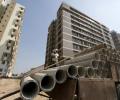
The report cautioned that low capacity utilisation and stressed balance sheets of banks and businesses will prevent a strong investment revival in the short term.

It emphasised that agricultural infrastructure needs considerable investments and hence Section 80IA benefits must be extended to all such investments like IT infrastructure, computers, VSAT, solar panels, water harvesting facilities, storage etc.

A bench headed by Chief Justice U U Lalit is scheduled to hear the petitions challenging the validity of the CAA whose enactment had triggered widespread protests across the country.

The two-wheeler sector has been underperforming its peers on the volumes front for over five quarters now. Even in the March quarter, Bajaj Auto and Hero MotoCorp posted a 17-24 per cent YoY decline in volumes, the sharpest in the listed auto universe. The ongoing impact of frequent price hikes, all-time high fuel prices, and muted rural sentiment has led to the lacklustre showing by two-wheeler makers. What has aggravated the situation for two-wheeler companies, which get almost all their sales from the internal combustion engine or ICE-based units, is the traction for electric two-wheelers (EV).

'If private capex has to kick in, there should at least be 2-3 years of visibility.'

How should one billion Indians, for whom deprivation has become an inescapable way of life, join us in celebrating 75 years of Independence? And where do we go from here? asks Kalyan Singhal.

Growth in India's manufacturing sector cooled to its slowest in 22 months in October.
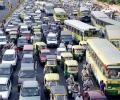
India has already pipped Japan as the world's third-largest oil consumer.

The economy is projected to clock 7.4 per cent growth.

We have the workforce, now we need to ensure that we take full advantage of game-changing technologies and geopolitical openings, suggests Jayant Sinha, chairman, Parliament's Standing Committee on Finance.

'We would like to develop Andhra Pradesh into a logistics hub not only for India, but also for South Asia.'
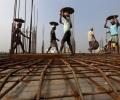
With this India will continue to retain the position of being the fastest growing emerging economy. And by 2021, its growth rate is projected to be 1.5 per cent more than China's 6 per cent.

'If you want it to grow well and serve the true needs of the economy, it needs a lot of freedom and flexibility, which comes in terms of the reform objective set by the regulator.'

The government has hiked gold import duty to 15 per cent from 10.75 per cent to check the current account deficit (CAD) and rising import of the yellow metal. The duty changes came into effect on June 30. Earlier, the basic customs duty on gold was 7.5 per cent, now it will be 12.5 per cent.

China criticised western attempts to "demonise" the BRICS.

In advanced economies, growth is strongest in the United States, says IMF.

Despite the wobble in the markets over the past few weeks, Indian equities remain expensive as measured by several yardsticks. India's market capitalisation-to-GDP ratio, for instance, has touched a multi-year high. The ratio is currently at 116 per cent, based on the FY22E gross domestic product (GDP) number, above its long-term average of 79 per cent.

Finance Minister Arun Jaitley on Friday tabled the pre-Budget Economic Survey in the Lok Sabha.

Finance Minister Nirmala Sitharaman is likely to strike a fine balance between being fiscally prudent and growth supportive when she presents her fourth straight budget on Tuesday, which is expected to have plans to boost spending to revive investment and create jobs. The Budget for the fiscal year starting April 1, 2022 is likely to raise spending on infrastructure to set the economy on a firmer footing. The stage for the Budget presentation was set by the Economic Survey stating that the government has the fiscal space to do more to support the economy that is forecast to grow at a healthy 8-8.5 per cent growth in the 2022-23 fiscal.

Titan was the top gainer in the Sensex pack, rising over 3 per cent, followed by M&M, Reliance Industries, Axis Bank, TCS, Maruti and Infosys. NSE Nifty surged 122.10 points to 15,885.15.

Maruti Suzuki India (MSI) on Thursday said its new manufacturing facility in Haryana, the company's third in the state, would reach peak production capacity of 10 lakh units per annum in the next eight years entailing a total investment of Rs 18,000 crore. The new facility, which would come at a 800-acre site at IMT Kharkhoda in Sonipat district, will entail total investment of Rs 11,000 crore in the first phase with a production capacity of 2.5 lakh units per annum. The first set of vehicles are expected to roll out from the facility in 2025.

Geopolitical concerns, earnings sees investors rush to safe haven plays post the Union Budget presentation in July.

India must be prepared for a big, fat fuel import bill in FY23 - barring any further avatars of the Covid virus - as refiners crank up runs, or crude processing rates, to meet the growing demand for fuels, and crude prices soar. Capacity additions by an Indian state-run refiner will reinforce the need for foreign crude. Demand for all fuels is expected to increase by 3-8 per cent next fiscal from 2021-22, reaching pre-pandemic levels, according to analysts and industry experts.

The dreary, cold months from December to February may prove to be the undoing of many a nation as they grapple with sky-high fuel prices - a result of the Ukraine conflict and the pandemic. Many - Europe, South Korea, Japan, and China - will still pull through on the strength of their wealth or because of strong storage infrastructure. But India will have its back to the wall. Signs of liquefied natural gas (LNG) rates hitting new records this winter are already evident.

The tourism industry plays a vital role in the town, accounting for 70 per cent of its economy, according to experts.

The RBI must cut rates to spur growth, say experts.

A reversal of policy at this juncture could jeopardise the recent gains on inflation

Echoing Prime Minister Narendra Modi's views that improving the health of financial markets alone cannot fuel growth, G20 business leaders on Friday said vigorous efforts should be made to go beyond fiscal and monetary policy to kickstart world economy and create jobs.

Poor governance and mediocre short-sighted politics are destroying the paradise that Goa was as its environment, water table, culture and way of life is drastically threatened by tourism and migration, points out Ramesh Menon.
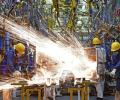
Operating margins for some companies dipped in Q3, 2021-22 but this sector could be nearing the bottom of the cycle in terms of profits.

'...Market-linked debentures, high-value insurance, exemptions from capital gains by investment in real estate, etc.' 'So, there are a number of measures directed at collecting a fair share from higher income individuals.'

To begin with, there would be the immediate integration of various technology stacks. This would create more business for global consulting and IT services entities such as KPMG, PwC, EY, Accenture and IBM, among others. Indian service providers - Infosys, Tata Consultancy Services (TCS), and Wipro, for instance - would also cash in.

Newer asset classes such as data centres and rental housing gained prominence among investors.

'The role reversal of those in favour of GST and those opposing it is troubling.'

The government's regional connectivity scheme UDAN has witnessed a slow progress of implementation, as not even 50 per cent of the route have been operationalised and the second wave of the pandemic, which started from mid of March 2021, may impact it further going forward, according to a report. Rating agency ICRA in its report on Tuesday said that there is likely to be a further delay of two years in achieving the target of operationalising as many as 100 unserved and underserved airports and starting at least 1,000 RCS routes by 2024. Aimed at enhancing regional connectivity through fiscal support and infrastructure development, the maiden flight under the Ude Desh Ka Aam Nagrik (UDAN) scheme was flagged off by Prime Minister Narendra Modi from Shimla for Delhi on April 27, 2017.

The Reserve Bank of India on Wednesday retained the economic growth projection for the current financial year at 10.5 per cent, while cautioning that the recent surge in COVID-19 infections has created uncertainty over the economic growth recovery. In its last policy review, the RBI had projected a GDP growth rate of 10.5 pc for FY'22. Taking various factors into consideration, it said, "the projection of real GDP growth for 2021-22 is retained at 10.5 per cent consisting of 26.2 per cent in Q1, 8.3 per cent in Q2, 5.4 per cent in Q3 and 6.2 per cent in Q4."

Finance Minister Nirmala Sitharaman on Monday said the government has come out with open and transparent Budget and has not made any attempt to hide anything under the carpet.
